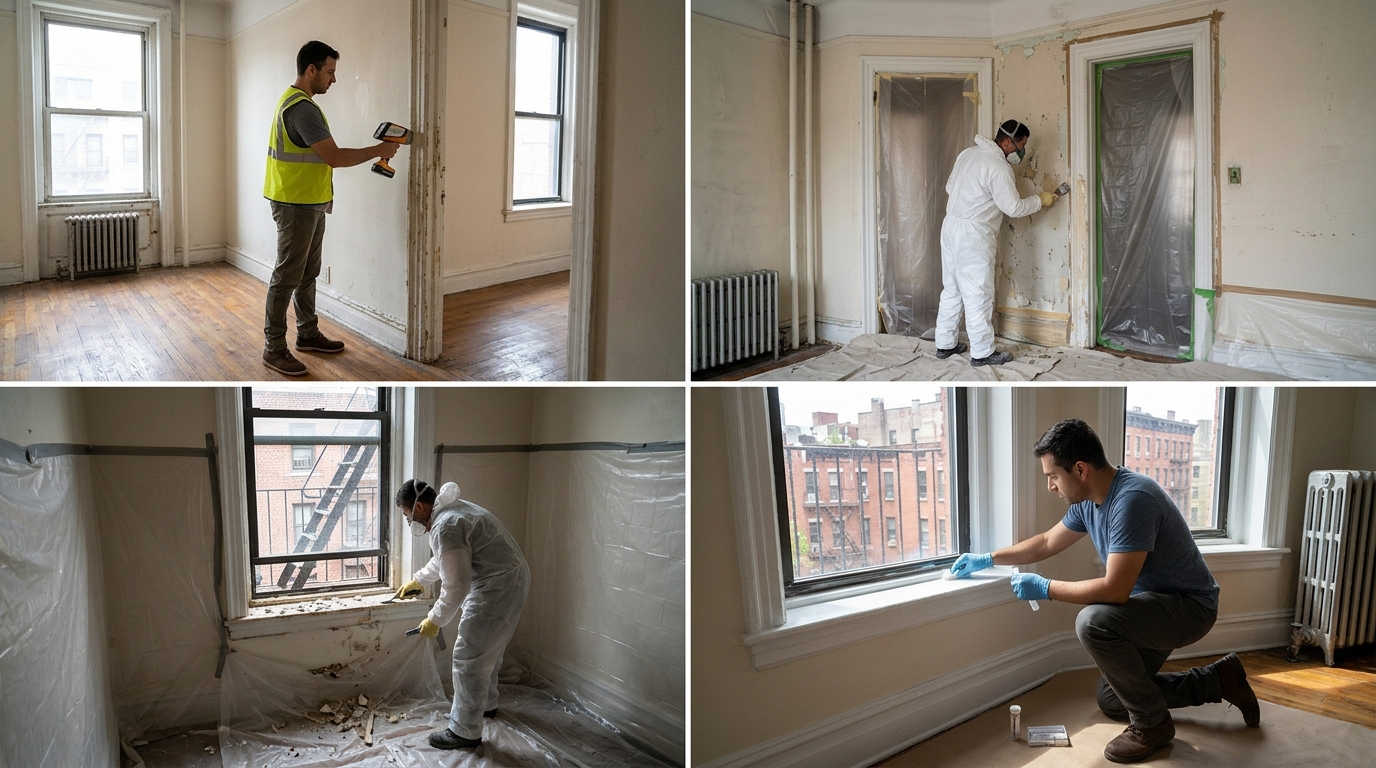
Many NYC property owners treat a negative XRF reading as the end of the job. Local Law 31 required XRF testing in pre-1960 rental units and common areas by August 9, 2025, and many owners now hold reports with negative readings.
Once the inspector leaves, those reports often go into a file and stay there untouched. In New York City, that habit can cost owners more than the original inspection.
Paint in buildings built before 1960 is presumed to contain lead until the owner proves otherwise, and that proof exists only on paper. Negative readings are valuable data in their own right, and proper negative XRF results documentation is what lets HPD, buyers, and future inspectors rely on them. Missing affidavits, incomplete readings, or outdated testing standards can weaken a report that looks clean. Those gaps tend to surface during an audit, an exemption filing, or a sale. Complete documentation turns a negative reading into lasting proof.
What a Negative XRF Result Means in NYC
About 34.6 million US homes, or 29.4% of all housing units, still contain lead-based paint. New York City sets a strict definition for that paint, and a negative result only counts when it meets that definition.
Negative, Inconclusive, and Positive Readings
Since December 1, 2021, NYC has defined lead-based paint as 0.5 mg/cm² or more of lead. XRF readings fall into three groups under that standard:
Negative: 0.4 mg/cm² or lower
Inconclusive: Exactly 0.5 mg/cm², treated as lead-based paint unless a lab paint chip test shows otherwise
Positive: 0.6 mg/cm² or higher
Only the first group counts as a negative result. Inconclusive readings stay presumed positive until a laboratory confirms the paint is below the limit.
The Exact Reading Behind a Negative Result
Readings of 0.0 mg/cm² and 0.4 mg/cm² are both negative, yet they describe very different surfaces. The second falls just below the limit and deserves closer attention on any later test. Some reports also list readings below zero, and those values reflect normal instrument precision instead of a faulty test. Reports that show only a pass or fail label leave out the detail an auditor or new inspector needs.
The Lead Presumption After a Negative Result
Local Law 1 presumes that paint in pre-1960 rental buildings contains lead. Negative test results support the case against that presumption, but the report by itself does not end an owner's annual duties. Annual notices and required investigations continue until HPD grants an exemption for the unit or common area. The paperwork behind the negative reading is what makes that exemption possible.
8 Reasons Why Negative XRF Results Still Need Proper Documentation
Negative XRF results need documentation because they prove compliance, hold up in HPD audits, protect owners against liability, and show the testing was done correctly. Strong negative XRF results documentation matters most in eight specific situations.
1. HPD Audits Look for the Testing Process
HPD reviews more than the final result during an audit. The agency expects to see where testing took place, who performed the work, and which equipment produced the readings. Missing unit records make the testing look incomplete. HPD has no way to credit a clean surface that no report confirms.
Testing records, EPA inspector certifications, and affidavits must stay on file for at least 10 years. Without proof that testing was completed, owners face a Class C violation with civil penalties of $1,500 per unit or common area.
2. Documented Results Support Due Diligence
Tenant complaints and lead claims can arise years after an inspection. Dated testing records show the owner tested on time, hired a certified inspector, and acted on the results. That history gives owners and their attorneys clear evidence of responsible management. Undocumented results leave the owner with nothing to present beyond memory.
Strong records also help when a tenant reports peeling paint or asks for proof of testing. Owners can share the inspection date, the certified inspector’s name, and the negative readings for that unit without delay. Prompt, accurate answers reduce disputes and build trust with tenants.
3. Complete Coverage Proves a Full Testing Program
HPD expects a full testing program across the building. Complete records cover:
All rental units, including vacant units
Co-op and condo units that are rented out
Common areas such as lobbies, hallways, and stairwells
Units the inspector could not enter, backed by a no-access affidavit
Gaps in coverage weaken the entire report. One untested unit can raise questions about the rest of the building.
4. Documentation Starts the Lead-Free Exemption
HPD recommends a Lead-Free Exemption for units and common areas that test negative throughout. The application depends on complete paperwork:
Filed through HPD's Lead Exemption Online Portal (LEOP)
Requires the Lead Testing Affidavit and the Lead Free No Abatement Affidavit
Accepts only testing from an XRF with an approved Performance Characteristic Sheet (PCS) at 0.5 mg/cm²
Once HPD grants the exemption, annual lead notices and annual investigations end for that unit. Lead-free areas also no longer require safe work practices during construction, and our guide to applying for a lead-free exemption covers the full process.
5. Turnover Work Depends on the Paper Trail
Pre-1960 rental units go through a documented inspection at turnover before the next tenant moves in. Painted window and door friction surfaces must also be abated at turnover unless testing shows the paint is negative. Clear records from a 0.5 mg/cm² test can prove those surfaces need no abatement. That proof saves time and cost when units become vacant.
Turnover work also creates its own paperwork, and owners must keep the turnover inspection records alongside the original XRF report. Gaps in those files can lead to an HPD turnover violation, often cited as Violation 623. Storing both documents together gives owners one complete record for that vacancy.
6. Old 1.0 mg/cm² Reports Lose Value
Before December 1, 2021: NYC used 1.0 mg/cm² as the lead-based paint standard, and HPD granted exemptions at that level.
After December 1, 2021: Reports at 1.0 mg/cm² still count for Local Law 31 compliance, yet they cannot prove a surface negative under Local Law 1 or satisfy turnover rules.
Exemptions granted at 1.0 mg/cm² also end at the unit's first turnover after that date. Owners who want a new exemption must retest at 0.5 mg/cm² with an approved instrument.
7. Records Move With the Building on Sale
HPD requires lead paint records to transfer to the new owner when a property is sold. Federal disclosure rules for pre-1978 housing also rely on these records:
Sellers and landlords must share available lead inspection reports with buyers and tenants
Signed disclosure forms must be kept for at least 3 years
Housing found free of lead-based paint by a certified inspector is exempt from the federal disclosure rule
Buyers often request these files during due diligence. Organized negative results make the sale process faster and reduce questions at closing.
8. Records Give Context in a Violation Dispute
HPD inspectors carry their own XRF analyzers and may issue violations based on their readings. Owners responding to an HPD lead violation can contest a violation issued at 0.5 mg/cm² with lab results from a paint chip sample. XRF results cannot be used for that challenge.
Since February 2026, owners can also challenge certain positive readings on metal or ceramic surfaces with paint chip testing. Documented negative readings on those components give the challenge clear context. Records of earlier negative readings on the same surface also help owners decide quickly whether a paint chip challenge is worth pursuing.
XRF Results Documentation Framework for NYC Properties
Complete negative XRF results documentation records the same core details for all tested surfaces. This framework shows what a complete negative XRF report should include:
What to Record | Why It Matters | Example Entry |
Unit, room, and component | Links the reading to the exact surface | Unit 4B, bedroom, window sill |
Substrate and paint condition | Records the surface type and its state | Wood, intact |
Numeric reading and result | Shows the value against the 0.5 mg/cm² threshold | 0.2 mg/cm², negative |
Instrument details | Proves the analyzer meets HPD standards | Model, serial number, PCS at 0.5 mg/cm² |
Calibration checks | Confirms the analyzer read correctly that day | Calibration readings before and after testing |
Inspector details | Shows a certified professional did the work | Name, EPA certification number, date and time |
Paint chip lab results | Resolves inconclusive readings | Lab report attached for any 0.5 reading |
Reports that include all seven details answer most audit questions before HPD asks them. Missing fields force owners to track down the inspector years later.
Credentials and Affidavits
The report also needs supporting documents that prove the inspector and the process met city rules:
EPA Certifications: Proof of certification for both the inspector and the inspection firm. Owners can confirm both through the EPA's lead professional locator.
Testing Affidavit: The HPD affidavit signed by the certified individual who performed the XRF testing.
Inspector Independence: Confirmation that the inspector is not the owner, the owner's agent, or a contractor hired for lead remediation.
No-Access Records: Affidavits and mailed notices for any unit the inspector could not enter, including the dates of all access attempts.
These documents carry as much weight as the readings themselves. Exemption applications and audits both depend on them.
Gaps That Weaken a Negative XRF Report
Some negative XRF results lose their value because of missing details or outdated methods. Watch for these common gaps:
Summary pages with no room-by-room readings
Missed common areas or vacant units
Testing done at the old 1.0 mg/cm² standard
Inspectors tied to the owner or an abatement firm
Inconclusive 0.5 mg/cm² readings never resolved with a paint chip test
No Performance Characteristic Sheet for the instrument
Any one of these gaps can force a retest or delay an exemption. Reviewing the report soon after the inspection gives owners time to request corrections while the inspector still has the field data.
Record Storage for Negative XRF Results
Good storage keeps your negative XRF results documentation ready for HPD, buyers, and future inspectors. Follow these steps to protect the records for the full retention period:
Keep the original report and a digital copy in separate places.
File records by building, unit, and common area.
Store EPA certifications and affidavits with the matching report.
Note the end date of the 10-year retention period for all tests.
Transfer the complete file to the new owner at sale.
Bring your testing records together in one view your team can reach at any time. Our client portal organizes your properties, inspection reports, and linked HPD violation records across your entire portfolio. Request a demo from our team at Manhattan Lead, and we will show you your buildings and their records side by side.
FAQs
Why do negative XRF results need documentation?
Negative XRF results documentation matters because NYC presumes paint in pre-1960 buildings contains lead. Complete records prove compliance during HPD audits, support lead-free exemptions, satisfy turnover rules, and protect owners when a property is sold.
How long must NYC landlords keep XRF test records?
NYC landlords must keep XRF testing records, inspector certifications, and affidavits for at least 10 years. HPD can request these files at any time, and the records must transfer to the new owner when the property is sold.
Do owners need to retest at 0.5 mg/cm² after testing at 1.0?
Retesting is not required for Local Law 31 compliance if the owner holds the original 1.0 mg/cm² XRF report. Owners who want a lead-free exemption or turnover relief must retest at 0.5 mg/cm² with a HUD-approved instrument.
Do negative XRF results need to be disclosed when renting or selling?
Federal rules require sellers and landlords of pre-1978 housing to share any available lead reports, including negative ones. Buyers also receive a 10-day window to arrange their own lead inspection unless they choose to waive it.
Can a negative XRF report remove an HPD lead violation?
Owner XRF reports cannot contest an HPD lead violation. Readings of 0.4 mg/cm² or lower do not trigger a violation. Violations at 0.5 mg/cm² can only be contested with lab paint chip results from the same surface.
The Bottom Line
Clean XRF readings only protect an owner when complete records stand behind them. Detailed reports, inspector credentials, and signed affidavits form the negative XRF results documentation that HPD, buyers, and future inspectors accept as proof. Owners who store that proof for the full 10 years keep their exemption options open and their turnover work simpler.
At Manhattan Lead Inspections, our EPA-certified, bonded, and insured inspectors perform independent XRF lead testing across all five boroughs. Our reports record all tested components in an HPD-ready format. We also support owners with the testing and paperwork needed for lead-free and lead-safe exemptions.
Book your inspection with Manhattan Lead and keep your negative results ready for any HPD review.