
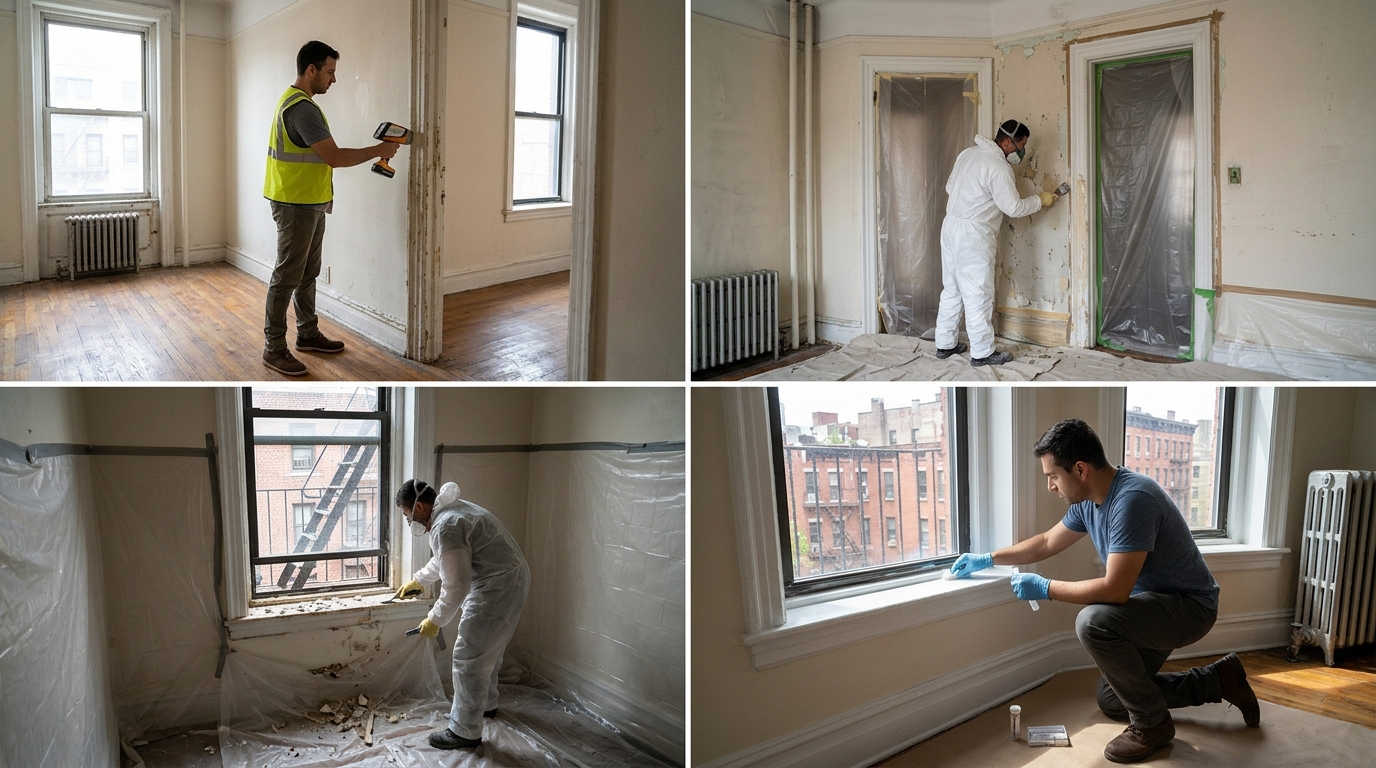
The last tenant has moved out, the unit is empty, and a new lease is already lined up. Before anyone moves in, owners of older NYC buildings have one more step to handle that often raises questions. Many are unsure what a lead inspection at turnover involves, who should perform it, and how it fits into the rest of the work.
A turnover lead inspection in NYC is the process of checking a vacant apartment for lead paint and lead hazards before the next tenant moves in. The inspection shows which surfaces need repair or abatement, guides the required turnover work, and ends with independent dust wipe clearance. Once the unit passes, the owner has the records needed to certify that the apartment is safe for the new tenant.
What Is a Turnover Lead Inspection?
A turnover lead inspection is a check of a vacant apartment to find lead-based paint and any conditions that could expose a new tenant to lead. Inspectors look for peeling paint, worn friction surfaces, and other hazards that must be corrected before move-in. The results give owners a clear picture of what work the unit needs.
This inspection is different from the annual visual check owners complete in occupied units. It happens every time an apartment turns over, and it is tied directly to the lead paint work NYC requires between tenants. Since the unit is empty, inspectors can reach every room, closet, and window without disrupting anyone.
When Is a Turnover Inspection Needed?
Not every apartment falls under NYC's turnover rules. The need for an inspection depends on the building's age, its testing history, and its exemption status. A turnover inspection is usually needed in these situations:
A Tenant Moves Out of a Pre-1960 Building: Every apartment in a multiple dwelling built before 1960 must be addressed at turnover.
A Unit Built From 1960 to 1978 Has Known Lead Paint: Owners who know lead paint is present must follow the same turnover rules.
An Old Lead-Free Exemption Is Revoked at Turnover: Exemptions granted under the earlier 1.0 mg/cm² standard end at the next vacancy.
The Unit Has Never Been XRF Tested: Without testing, owners have no proof of which surfaces contain lead paint.
The XRF testing deadline for older buildings has already passed. HPD required owners of residential buildings built before 1960 to complete XRF lead-based paint testing in all units and common areas by August 9th, 2025. Any unit that still has not been tested is out of compliance, and a vacancy is the simplest time to close that gap without disturbing a tenant.
What a Turnover Lead Inspection Includes
A complete turnover inspection combines several checks, each with its own purpose. The following are the main parts of the process from start to finish.
Visual Inspection of Painted Surfaces
The inspection starts with a room-by-room look at every painted surface in the apartment. The inspector notes peeling, chipping, or cracked paint, along with water damage, leaks, and other defects that cause paint to fail.
Friction and impact points get extra attention. Doors that stick, windows that grind in their channels, and edges with bite marks are all common sources of lead dust. These findings help the owner and contractor plan the exact scope of turnover work.
XRF Testing for Lead-Based Paint
XRF testing uses a handheld analyzer to measure the lead content of paint on a surface. The device reads through every layer of paint at once, so inspectors can identify lead-based paint without scraping or damaging walls and trim.
Testing is the only reliable way to know what is under the top coat. When the city's public housing authority XRF tested 109,952 units under the current standard, 46% tested positive for lead-based paint. Results that show no lead-based paint can also support an application for a lead-free exemption, which removes the need for turnover work in future vacancies.
Paint Chip Sampling When Needed
Some surfaces need a second method of testing. Paint chip sampling is often used in these cases:
An XRF reading comes back inconclusive
A surface is hard to read with an analyzer
An owner needs laboratory confirmation of a result
The inspector removes a small sample from the surface and sends it to a laboratory for analysis. This step adds certainty when an XRF result alone does not settle the question.
Dust Wipe Clearance After the Work
Clearance testing is the final part of the inspection process. After the turnover work and final cleanup are complete, an independent inspector collects dust wipe samples from floors, windowsills, and window wells.
These samples are analyzed by a laboratory certified by New York State. If the results fall within the allowed dust levels, the unit is cleared for move-in. If not, the affected areas must be cleaned and tested again.
Surfaces Inspectors Check During Turnover
Lead hazards tend to appear in the same parts of an apartment again and again, especially in areas that see constant movement, moisture, or contact. During a turnover inspection, inspectors pay close attention to these surfaces:
Door and window friction surfaces
Windowsills and window wells
Chewable edges and railings
Bare floors
Walls and ceilings with peeling paint
Closet interiors
Many of these surfaces look fine at a glance but still release lead dust through daily use, such as opening a window or closing a door. Closets and other low-traffic spaces are also easy to overlook, even though their paint can be just as old as the rest of the unit. A careful check of each one keeps hidden hazards from slipping through to the new tenant.
How the Turnover Inspection Process Works
A turnover inspection follows a clear sequence that fits into the time between tenants. Most turnovers move through these steps:
Schedule the Inspection: Book the inspection as soon as the tenant moves out to leave time for any needed work.
On-Site Inspection and XRF Testing: The inspector checks every painted surface and tests where needed.
Review Findings and Hire a Certified Contractor: The report shows which surfaces need repair or abatement.
Turnover Work and Final Cleanup: The contractor completes the work using safe work practices.
Independent Dust Wipe Clearance: A separate inspector collects samples for lab analysis.
Report and Records: The owner files the results and certifies compliance on the lease notice.
Planning each step early helps the unit return to the market on schedule. Tell us the move-out date and the age of your building, and our team at Manhattan Lead will set up your turnover lead inspection in NYC around that timeline, from XRF testing through final clearance.
Reach us at (212) 226-1614 to reserve a time that keeps your lease date on track.
How to Prepare a Vacant Unit for Inspection
A little preparation helps the inspection go smoothly and keeps the results accurate. Owners can get the apartment ready with these steps:
Keep Power and Access Available: Make sure the inspector can enter the unit and that lights are working in every room.
Clear the Unit of Belongings and Debris: Empty rooms allow full access to floors, walls, and closets.
Make Windows and Doors Accessible: Remove anything blocking windows, sills, and door frames.
Have Past Lead Records Ready: Previous XRF reports, exemptions, and turnover records help the inspector understand the unit's history.
A prepared unit can often be inspected in a single visit. It also reduces the chance of missed surfaces that could cause problems later.
What Happens After a Turnover Inspection
The next steps depend on what the inspection and clearance testing find. These are the most common outcomes:
The unit passes clearance, so the owner certifies the lease notice and files the records
The unit fails clearance, so the affected areas must be cleaned and retested
XRF testing finds no lead-based paint, so the owner can apply for a lead-free exemption
Records from the inspection matter well beyond move-in day. Under Local Law 123 of 2023, when HPD issues a turnover violation, the owner has 45 days to provide records, and on and after August 1, 2025, those records must include any XRF analysis. Keeping complete inspection reports makes this step simple if HPD ever asks.
FAQs
Is a turnover lead inspection required in NYC?
Yes, owners of covered apartments must identify and correct lead paint hazards at every turnover and keep inspection records. Independent dust clearance testing is also required after turnover work and before the new tenant moves in.
How long does a turnover lead inspection take?
The on-site inspection and XRF testing of a typical apartment can often be completed in a single visit. Dust wipe clearance happens later, after the work is done, and lab results usually take a few business days.
Can the contractor who did the work also do clearance testing?
No, NYC requires dust wipe clearance after turnover work to be performed by a firm independent of both the owner and the contractor who completed the work. This keeps the results unbiased and credible during an HPD audit.
What happens if the apartment fails dust clearance?
If any sample is above the allowed lead dust level, the affected areas must be cleaned again and retested. The new tenant cannot move in until the apartment passes clearance and the results are on file.
Does XRF testing damage painted surfaces?
No, XRF testing is non-destructive. The handheld analyzer reads lead content through every layer of paint without scraping, drilling, or removing anything, so walls, doors, and trim stay intact and ready for any repairs that follow.
Conclusion
A turnover inspection gives owners a clear view of the lead hazards in a vacant apartment before the next tenant arrives. It combines a visual check, XRF testing, and independent dust wipe clearance to confirm the unit is safe. Scheduling a turnover lead inspection in NYC as soon as a tenant moves out keeps the work organized, the records complete, and the lease date on track.
Manhattan Lead Inspections has completed more than 15,000 XRF inspections and 3,000 clearance tests for property owners across New York City. Our bonded and insured team handles every stage of a turnover inspection, from the first visual check to paint chip sampling and lab-confirmed results when a reading needs a second look. Portfolio owners can follow each unit’s testing, reports, and open violations through our client portal, which makes turnovers across several buildings far easier to manage.
An empty apartment is the easiest one to inspect, so book your turnover inspection in NYC with Manhattan Lead at (212) 226-1614 while the unit is still vacant.