
How Long Must NYC Landlords Keep Lead Paint Records?
Under New York City lead-paint requirements, property owners generally must retain lead-related records for no less than 10 years. HPD applies that retention period across multiple types of documentation, including annual notices, investigations, XRF testing, turnover work, remediation activities, and safe-work records.
The 10-year requirement is particularly important for owners and managing agents because compliance may be reviewed long after the work took place. A property may change management companies, contractors, employees, or ownership interests during that period, but the building’s records still need to be available.
A practical recordkeeping system should therefore preserve records by:
- Property address
- Apartment number
- Calendar year
- Type of lead-related activity
- Date the activity occurred
- Contractor or inspector
- Supporting report, affidavit, or certification
Saving a document without being able to identify which apartment, year, or repair it relates to can make responding to an HPD request unnecessarily difficult.
Which Lead Paint Records Do NYC Landlords Need to Keep?
There is no single document that satisfies NYC lead-paint recordkeeping requirements. HPD may request records covering several different obligations.
-
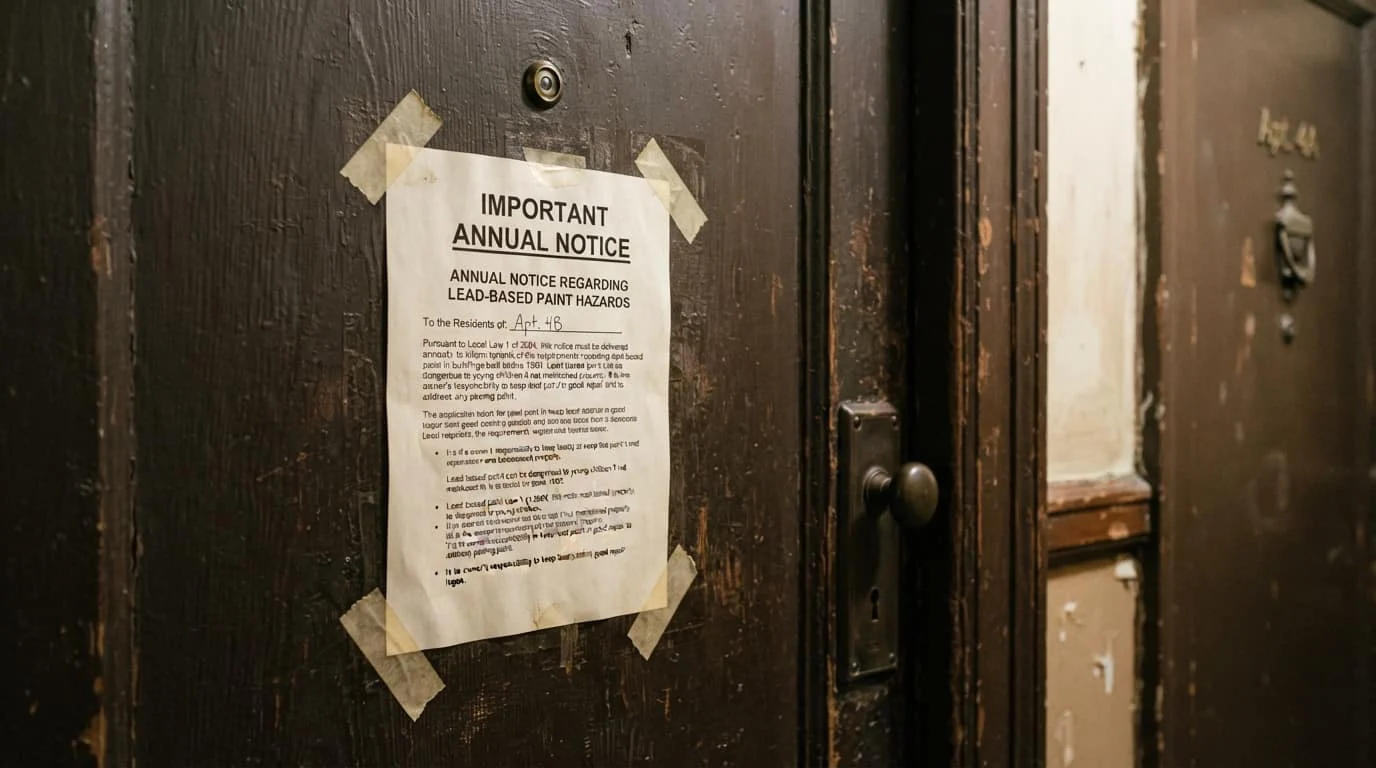
Annual Notice Distribution and Tenant Responses
Covered owners must maintain documentation related to the annual process used to determine whether a child under six resides in a dwelling unit.
Records should show that required annual notices were distributed and should preserve tenant responses. When an annual notice indicates that a child under six resides in an apartment, that information may trigger additional investigation and lead-hazard responsibilities. HPD specifically identifies annual notice distribution and collection records as documents that may be demanded during a compliance audit.
A complete annual-notice file should generally make it possible to determine:
- Which apartment received a notice
- When the notice was delivered
- Whether the tenant responded
- What the response said
- Whether additional follow-up was required
- What happened if the tenant did not respond
Landlords should avoid relying on memory, informal spreadsheets without supporting documents, or a general statement that notices were sent building-wide.
-
Annual Visual Investigation Records
When a child under six resides in an applicable unit, annual visual investigations are part of the owner’s continuing lead-paint responsibilities. HPD can request records showing that these investigations were performed.
The record should be detailed enough to establish what was actually inspected and what was found. Depending on the circumstances, documentation may include:
- Date of the investigation
- Unit inspected
- Name of the person performing the investigation
- Painted surfaces or areas reviewed
- Peeling or deteriorated paint identified
- Conditions that could contribute to deterioration
- Corrective action taken
- Follow-up inspection information
If a problem was discovered, the file should connect the investigation to the repair records rather than treating the two events as unrelated paperwork.
-
XRF Lead Paint Testing Records
XRF records have become one of the most important parts of a landlord’s compliance file.
The August 9, 2025 deadline for required XRF testing has passed. Covered properties were required to have applicable dwelling units and common areas tested using an XRF device by an EPA-certified lead inspector or risk assessor who is independent of the owner and any company hired to perform lead-paint remediation.
Owners must maintain records from that testing for at least 10 years. HPD specifically identifies the following documentation:
- Names of inspectors or contractors who performed the inspection
- Proof that the inspector was EPA certified
- Proof of the testing firm’s qualifications
- XRF testing reports and results
- Required affidavits
- Documentation of attempts to obtain access when testing could not be completed
XRF testing is generally a one-time requirement rather than an annual inspection, but the resulting records must remain available for audit purposes.
For owners who completed testing before the deadline, the priority now is making sure the original reports and certification documents can actually be located.
-
Records of Attempts to Gain Access
A tenant refusing or failing to provide access does not mean the owner should leave a blank space in the compliance file.
For XRF testing, HPD instructs owners to document attempts to contact and notify occupants, including dates, times, methods of communication, written access notices, and the reasons access could not be obtained. HPD may review those documents when determining whether the owner complied with the testing requirement.
Similar documentation is valuable whenever access prevents required lead-related work from being completed.
Keep:
- Written notices requesting access
- Proof of mailing or delivery
- Emails or other communications
- Dates and times of attempted appointments
- Rescheduling attempts
- Notes explaining why access failed
- Relevant affidavits or no-access forms
A well-documented unsuccessful attempt is very different from having no record that an attempt was ever made.
-
Turnover Inspection and Work Records
Lead-paint obligations do not stop when a tenant moves out. Apartment turnover creates its own set of responsibilities.
HPD states that required turnover work must be completed before a new tenant takes occupancy. Depending on the property’s lead status, turnover work can include correcting peeling paint, addressing underlying defects, treating chewable surfaces, abating lead paint on door and window friction surfaces, and making certain floors, windowsills, and window wells smooth and cleanable.
For recordkeeping purposes, owners must maintain:
- Turnover inspection records
- Documentation of work performed
- Contractor certifications
- Safe-work-practice documentation
These records must be retained for at least 10 years.
Turnover documentation deserves particular attention because HPD now considers turnover-related violations when selecting buildings for lead audits. Local Law 127 of 2023 added turnover violations as an audit-selection criterion beginning in September 2024.
-
Lead-Safe Work Practice Documentation
Whenever work disturbs lead-based paint—or paint whose lead content has not been established—additional documentation may be necessary.
HPD’s safe-work guidance explains that owners may need records establishing that appropriately certified firms and workers performed the work and that required containment, cleaning, and clearance procedures were followed.
Depending on the job, a compliance file may need to include:
- EPA certification for the firm
- EPA certification for the worker or supervisor
- Contractor affidavits
- Dates work began and ended
- Description of the work
- Location of work within the apartment
- Invoices or scopes of work
- Proof that required lead-safe practices were followed
- Dust-clearance testing documentation
For certain work, clearance sampling must be performed independently from the company performing the remediation or abatement.
This documentation helps establish not simply that a wall, door, or window was repaired, but that the work was performed using the procedures required for lead-paint conditions.
-
Lead Violation Correction Records
If HPD or another city agency issues a lead-based paint hazard violation, keep the entire correction file together.
That may include:
- Original violation notice
- Inspection or testing reports
- Contractor documentation
- Evidence of lead-safe work practices
- Clearance test results
- Repair invoices
- Certifications submitted to HPD
- Correspondence with the agency
- Confirmation that the violation was corrected or closed
HPD specifically requires records of work performed to correct open or uncertified lead-based paint hazard violations, including documentation of the work practices used.
For a landlord or managing agent handling several buildings, separating closed-violation documentation from general maintenance files can make future audits much easier to manage.
What Is an HPD Record Production Order?
An HPD Record Production Order, often shortened to RPO, is a formal demand for documentation showing that an owner complied with New York City’s lead-paint requirements.
When an RPO is issued, HPD states that the owner must provide the requested records within 45 days.
The requested file may include:
| Record category | Examples |
| Annual notices | Distribution records and tenant responses |
| Annual investigations | Visual investigation documentation |
| Hazard correction | Repair and remediation records |
| Non-violation work | Safe-work-practice documentation |
| Turnover | Inspection, contractor, work-practice and clearance records |
| XRF testing | Inspector credentials, firm qualifications and testing reports |
HPD can issue violations when an owner fails to supply appropriate documentation. Current audit orders include records of requests covering turnover documentation, annual notice and investigation records, remediation activities, and XRF testing.
What Happens If Lead Paint Records Are Missing?
Missing records can become a compliance problem even when an owner believes the required work was completed.
HPD states that an owner who does not respond to a Record Production Order or provides incomplete records can receive immediately hazardous Class C violations and additional violations. HPD’s current recordkeeping guidance identifies a civil penalty of $1,000 to $5,000 for failure to comply with the applicable RPO requirement.
Recent enforcement shows why documentation deserves attention. In March 2026, HPD announced more than $150,000 in civil penalties from a lead-based paint recordkeeping enforcement action involving a particular property portfolio. HPD said its audits reviewed inspection reports, annual notices, turnover documentation, and compliance with lead-safe work practices. That amount relates to a specific enforcement case and should not be interpreted as the standard penalty for every recordkeeping problem.
The practical issue is simple: if an agency asks what happened in an apartment six years ago, an owner’s answer needs to be supported by documentation.
Local Laws 122, 123 and 127 Changed the Recordkeeping Landscape
Several 2023 local laws strengthened how lead-paint documentation is used in enforcement.
Local Law 123 of 2023 requires owners to provide annual notice and investigation records when certain lead-paint hazard or turnover violations are issued. It also expanded the circumstances in which XRF documentation must be produced.
Local Law 127 of 2023 added turnover violations to the criteria HPD can consider when selecting buildings for audits.
Local Law 122 of 2023 created a pathway for addressing certain recordkeeping violations where a complete 10-year file is unavailable. HPD’s current guidance says owners or managing agents with certain 618, 619, and 620 orders may seek dismissal using the three most recent years of acceptable documentation while paying applicable fees for unavailable or unacceptable years. This should not be treated as a substitute for maintaining the required 10-year record in the first place.
How Should Landlords Organize Lead Paint Compliance Records?
There is no benefit to having every required document if nobody can find it when HPD asks.
A practical folder structure might look like this:
Building Address → Calendar Year → Apartment → Compliance Category
Within each apartment file, separate:
- Annual notices and tenant responses
- Annual investigations
- XRF reports and inspector credentials
- Access attempts
- Turnover records
- Repair and remediation records
- Contractor certifications
- Safe-work documentation
- Dust-clearance results
- HPD or DOHMH correspondence
For managing agents, it is also useful to maintain a building-level compliance summary showing which units have completed XRF testing, which contain identified lead-based paint, which have exemptions, which have children under six, and which units have had a turnover.
The summary is a management tool, not a replacement for the underlying records.
Lead Paint Recordkeeping Checklist for NYC Landlords
Before considering a property’s lead file complete, confirm that you can locate:
- Annual notice delivery records
- Tenant annual-notice responses
- Annual investigation reports
- Records for nonresponsive or no-access units
- XRF inspection reports
- EPA inspector certification information
- EPA firm qualification records
- XRF affidavits where applicable
- Common-area testing records
- Turnover inspection records
- Documentation of turnover work
- Contractor certifications
- Safe-work-practice records
- Dust-clearance results
- Lead-hazard repair records
- Lead violation correction documents
- HPD or DOHMH correspondence
- Lead-Free or other applicable exemption records
- Documentation showing records have been retained for at least 10 years
If one of these categories applies to the property, but the supporting documentation cannot be found, identify the gap before an HPD audit or violation forces the issue.
Do Not Wait for an Audit to Build the File
The best time to organize lead-paint documentation is before HPD requests it.
Review every building separately. Confirm that annual notices and investigations are available, match turnover files to the apartments where tenants changed, preserve contractor and clearance records, and make sure required XRF reports include the inspector and firm documentation needed to establish that the testing was properly performed.
The August 2025 XRF deadline has already passed, and HPD’s current enforcement process puts significant emphasis on whether owners can produce records—not merely whether they say the work occurred.
If XRF testing was never completed or the required testing records for a building are missing, Manhattan Lead provides independent, EPA-certified XRF lead inspections for NYC landlords, property owners, and managing agents. The team performs lead inspections across New York City and provides documented testing results that can be retained as part of the property’s compliance file. Call to discuss your building or schedule an inspection.