
How Long Is the NYC Lead Paint Record Retention Period?
The basic answer is at least 10 years.
NYC HPD states that property owners generally must retain lead-based paint records for a minimum of 10 years and provide them when HPD requests them. HPD also states that XRF testing records, EPA inspector certifications, and testing affidavits must be maintained for at least 10 years.
The rule covers more than one type of document. Owners should build a record history that follows the property and its lead compliance activity over time.
For a property manager handling several buildings, this means a report completed in 2026 may still need to be available years later. Staff can change, management companies can change, vendors can close, and ownership can transfer. The compliance file still needs to remain available.
Does the 10-year period apply to XRF testing records?
Yes. HPD states that testing records from mandated XRF inspections must be kept for 10 years and supplied to the department when requested. HPD also says owners should retain proof of the inspector’s qualification and the testing firm’s EPA certification.
This matters because Local Law 31 testing is not based on an owner’s statement that the building was inspected. The records are what show that the required inspection took place.
Which Lead Paint Records Should NYC Landlords Keep?
A file marked “lead inspection” with one PDF inside may not contain everything an owner needs.
A stronger property record should include documents from each part of the lead compliance process.
Keep records such as:
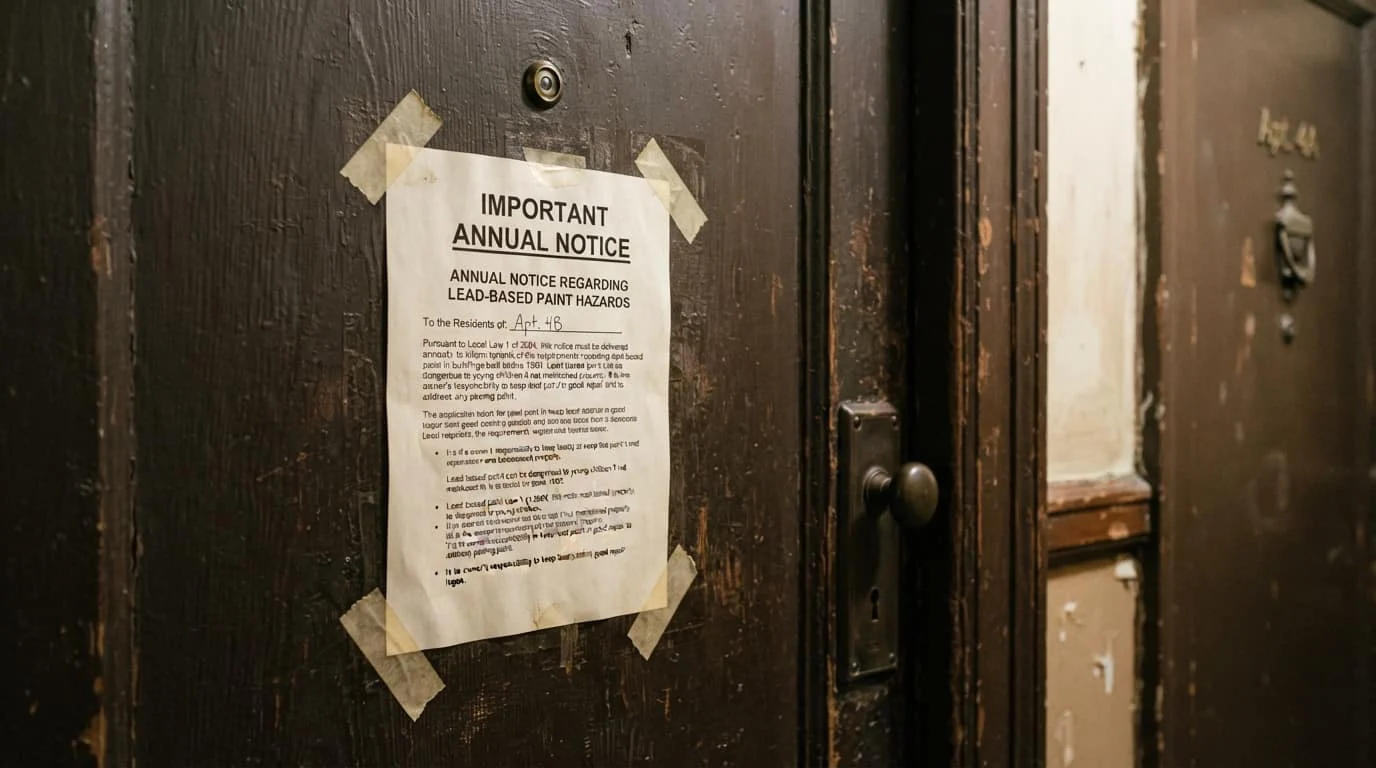
- Annual lead paint notices sent to occupants
- Tenant responses to annual notices
- Records showing whether a child under six resides in a unit
- Annual investigation and inspection records
- XRF inspection reports
- Names of inspectors and contractors
- EPA certification records for inspectors and testing firms
- Affidavits connected with XRF testing
- Lead paint test results for dwelling units
- Test results for covered common areas
- Records of repair, remediation, or abatement work
- Dust wipe clearance results when required
- Turnover inspection and correction documents
- Lead-Free or Lead-Safe exemption records
- Records showing attempts to gain access to a unit
These records answer different questions. An XRF report may prove testing, but it does not replace an annual notice. A remediation invoice may show that work was performed, but it may not prove that required clearance testing followed.
That distinction becomes important during an HPD request.
Why an XRF Report Alone May Not Complete the File
Local Law 31 brought a major testing requirement into NYC lead compliance. Covered rental units and common areas were required to undergo XRF testing by an EPA-certified inspector or risk assessor who is independent of the owner and any firm hired for lead remediation.
HPD says the testing requirement applies to covered properties built before 1960 and certain rental properties built from 1960 through 1978 where the owner has actual knowledge of lead-based paint. The August 9, 2025 deadline has passed.
After completing XRF lead testing, owners should preserve the complete testing package rather than only the final page showing results.
The file should identify:
- The property and unit tested
- The date of inspection
- The person who performed the inspection
- The inspector’s EPA qualification
- The testing firm’s qualification
- The surfaces and components tested
- The XRF results
- Any affidavit or supporting testing form
This creates a record that can be traced from the property to the inspection and from the inspection to the qualified person who performed it.
Common-Area Lead Records Need the Same Attention
Recordkeeping should not stop at apartment doors.
Local Law 111 extended the XRF testing obligation to common areas in covered buildings. HPD lists areas such as public hallways, stairwells, and other common spaces as part of the testing requirement. The same August 9, 2025 deadline applied.
This creates a problem for buildings where management collected unit reports but never built a separate common-area file.
A managing agent reviewing a property’s records should be able to answer two questions without searching through years of email:
- Where are the XRF reports for every covered dwelling unit?
- Where are the reports for the building’s covered common areas?
If the second group cannot be located, the building’s documentation review is not complete.
This is one reason portfolio managers should organize records by building first, then separate dwelling-unit and common-area documents inside each property file.
What Records Matter When a Tenant Does Not Provide Access?
No-access units can create another recordkeeping issue.
HPD tells owners to document attempts to obtain access for required XRF testing. The current guidance calls for keeping records of contact attempts, notices, and reasons access could not be obtained. HPD also describes documentation involving written notices and proof of mailing where access is denied.
This means a landlord should not treat a missed appointment as the end of the paper trail.
Keep:
- Copies of written access notices
- Dates notices were sent
- Proof of mailing where applicable
- Dates of attempted inspections
- Records of calls, emails, or other contact
- Notes showing why access was not obtained
- Any required no-access affidavit
- Records of later attempts to complete testing
These records may help show that the owner did not ignore the testing requirement and had been working to gain entry.
For larger portfolios, a no-access log can prevent the same unit from disappearing from the compliance schedule after one failed appointment.
Lead Paint Records Can Become Critical During an HPD Audit
The value of record retention becomes clear when HPD asks for documents.
HPD’s recordkeeping guidance lists several lead-related record-production orders. Some require owners to provide records covering the previous 10 years, including documentation related to notices, inspections, and remediation or abatement work.
HPD lists order numbers 618 and 620 as requiring production of required lead records for the last 10 years within 45 days of the request. Order 623 concerns turnover records, while order 626 concerns documents showing compliance with XRF testing.
This changes how landlords should view old files.
A document from seven years ago may look useless during normal property operations. During a record-production request, it may become part of the proof HPD expects to see.
What Happens If a Landlord Cannot Find 10 Years of Records?
Missing records can create a problem even when work may have been performed.
HPD explains that owners who receive certain recordkeeping violations can only comply by producing the required documentation. For some record-production orders, HPD provides a dismissal route where an owner cannot produce the full 10 years.
For orders 618, 619, and 620, HPD states that an owner may seek dismissal by submitting acceptable records for the three most recent years and paying $1,000 for each year of the 10-year period for which acceptable records are not submitted.
That is not a reason to plan around missing records. It shows why document storage should be treated as part of compliance work.
Consider an owner who manages several buildings and changes management companies. If old lead files stay with the former manager, the owner may later have to reconstruct years of notices, inspections and repair records under a deadline.
Recovering documents after HPD asks for them is much harder than maintaining the file when each task is completed.
Lead Paint Records Should Follow the Property After a Sale
Selling a building does not make the compliance history disappear.
HPD states that when ownership changes, required lead paint records must be transferred to the new owner.
This makes record organization part of property transfer work.
The outgoing owner should not hand over a folder containing random reports without context. The new owner or manager needs to understand what has been completed and what may still need attention.
A transfer file can be organized into:
Building information
Include the building address, construction year, unit list, and relevant property information.
XRF testing
Keep unit reports, common-area reports, inspector information, firm certifications, and testing affidavits together.
Annual compliance records
Store annual notices, tenant responses, investigations and related documentation by year.
Work and clearance
Keep repair, abatement, remediation, and clearance documentation together so the work history can be followed.
Turnover files
Maintain records for work completed when apartments became vacant and were prepared for new occupants.
Exemptions
Keep HPD exemption approvals and the testing or abatement documentation supporting them.
A building with a clear record history is easier for a new owner, attorney, or managing agent to review.
Should Landlords Delete Records After 10 Years?
Treat 10 years as the minimum retention period, not an automatic deletion date.
HPD’s language states that lead records generally must be retained for at least 10 years. It also tells property owners to keep records produced from mandated testing and records connected with access attempts.
Before destroying an older record, an owner should check whether it still supports another current document, exemption, open issue, building transfer, audit, or legal matter.
Digital storage makes longer retention easier than it was when building records depended on filing cabinets. Keeping older XRF reports and property compliance files can also help future management understand what was tested and when.
Where a legal dispute or open agency matter exists, owners should obtain advice about the records that must remain preserved.
A Simple Record System for Managing Agents and Landlords
A recordkeeping system does not need complicated software. It needs consistency.
For each property, create one lead compliance folder. Inside it, use sections based on the type of obligation rather than storing everything by vendor.
A practical structure can look like this:
- Annual notices and tenant responses
- Annual investigations
- XRF unit testing
- XRF common-area testing
- EPA certifications and affidavits
- Access and no-access records
- Turnover compliance
- Remediation and abatement
- Dust clearance testing
- HPD or DOHMH correspondence
- Exemptions
- Violations and closeout records
Then place the year in every file name.
For example, a report name that contains the property, unit, document type, and year is much easier to find than a file called “scan0047.pdf.”
Managing agents should also keep a property-level index showing which units were tested, when testing occurred, whether common areas were completed, and where the report is stored.
That index does not replace the records. It helps staff locate them before a deadline starts creating pressure.
How Often Should Lead Compliance Files Be Reviewed?
Waiting for HPD to ask for records is poor timing for the first file review.
A landlord or managing agent can review the file when a compliance event changes the property’s record history.
Useful review points include:
- After XRF testing
- After an apartment turnover
- After lead repair or abatement work
- After clearance testing
- When a child under six begins residing in a covered unit
- When an HPD or DOHMH violation is received
- During a management-company change
- Before a sale or refinance
- When taking over a new property or portfolio
The review should answer one basic question: if HPD requested the required lead records today, could the person responsible for the building locate them without reconstructing the history?
If the answer is no, the record system needs work.
Record Retention Is Part of Clearing Lead Violations
An owner facing an HPD lead violation may focus on correcting the physical condition. That is only one part of the response when records are also requested.
Inspection, correction, clearance, and documentation may each have a role depending on the violation.
A managing agent should first identify the exact order or violation, then gather the records connected with it. Guessing which paperwork HPD wants can waste part of a short response period.
This is also why records should remain connected to each unit. A portfolio may contain hundreds of lead documents, but HPD may be asking for the history of one apartment, one turnover, or one building.
The 10-Year Rule Is a Minimum, but the File Has Long-Term Value
The simplest answer to how long NYC landlords should keep lead paint records is at least 10 years.
The more useful answer is that owners should maintain a continuous lead compliance history for each covered property.
That history should include annual notices, investigations, XRF reports, inspector qualifications, common-area testing, access attempts, turnover records, remediation documents, clearance results, and exemptions. When ownership changes, the records must move to the next owner.
Lead paint record retention in NYC requirements can become important long after an inspection date has passed. A report that looks like old paperwork today may be the document needed for an HPD request, a property transfer, or a violation response years later.
Get Your NYC Lead Testing Records in Order Before HPD Asks
Missing documentation becomes harder to fix once a deadline starts.
Manhattan Lead Inspections provides independent, EPA-certified lead inspection and XRF testing for NYC property owners and managing agents. If your building still needs Local Law 31 testing, common-area testing, documentation connected with a violation, or a review of what was previously tested, the first step is identifying the missing part of the file.
Contact Manhattan Lead to schedule an inspection or discuss the testing records needed for your NYC property.