What Is Lead Dust Wipe Clearance Testing?
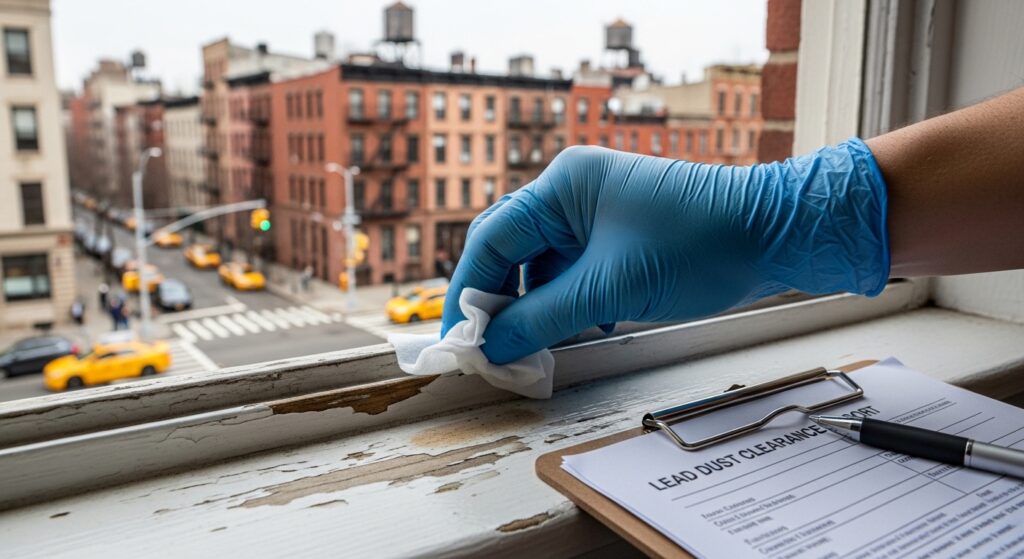
Lead dust wipe clearance testing is a post-remediation inspection process used to confirm that lead paint abatement or remediation work has been completed properly, safely, and in compliance with applicable standards. After any lead abatement, encapsulation, or paint disturbance work, certified inspectors collect dust wipe samples from floors, window sills, and window troughs — the surfaces most prone to lead dust accumulation — and send them to an accredited laboratory for analysis.
If the laboratory results fall below the federally established clearance levels, the work area is deemed safe for occupancy. If the results exceed those levels, additional cleaning and re-testing are required.
This process is not optional. For properties in New York City, lead dust wipe clearance testing is a regulatory requirement that protects tenants — especially young children — from dangerous lead dust exposure.
Why Lead Dust Wipe Clearance Testing Matters
Lead poisoning is one of the most serious preventable health hazards for children under six years old. Even low levels of lead exposure can cause irreversible neurological damage, learning disabilities, behavioral problems, and developmental delays.
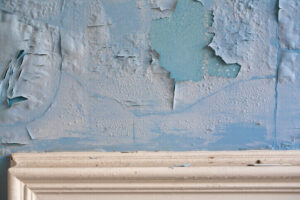
When lead paint is disturbed — through sanding, scraping, renovation, or deterioration — it releases microscopic lead dust particles that settle on floors, window sills, and other surfaces. These particles are invisible to the naked eye, making professional testing the only reliable way to verify that a space is truly safe.
Lead dust wipe clearance testing provides:
- Objective, laboratory-verified proof that abatement work was effective
- Legal protection for property owners who have complied with remediation orders
- Peace of mind for tenants and families re-entering a treated space
- Documentation needed to close out violations with city agencies
Without clearance testing, there is no way to confirm that an abatement contractor’s work actually achieved the intended result.
How Lead Dust Wipe Clearance Testing Works
The clearance testing process follows a strict protocol:
Post-Abatement Cleanup: The abatement contractor completes all work and performs a thorough cleaning of the work area.
Certified Inspector Sampling: A certified lead inspector or risk assessor — independent from the abatement contractor — collects dust wipe samples from designated surfaces using standardized methods.
Accredited Laboratory Analysis: Samples are submitted to an EPA-accredited laboratory where they are analyzed for lead content in micrograms per square foot (µg/ft²).
Results Compared to Clearance Levels: Results are compared against NYC’s updated clearance standards:
- Floors: 5 µg/ft²
- Window Sills: 40 µg/ft²
- Window Wells (Troughs): 100 µg/ft²
Clearance Report Issued: If all samples pass, a formal clearance report is issued, confirming the space is safe and compliant.
In New York City, this report is often a required deliverable for closing out violations with the Department of Health and Mental Hygiene (DOHMH), the Housing Preservation and Development department (HPD), and the Department of Buildings (DOB).
Updated NYC Lead Dust Clearance Standards
New York City has adopted stricter clearance standards than the older federal HUD thresholds. Property owners and contractors must meet the following limits for a space to receive clearance:
- Floors: 5 µg/ft² (previously 10 µg/ft²)
- Window Sills: 40 µg/ft² (previously 100 µg/ft²)
- Window Wells (Troughs): 100 µg/ft²
These updated standards reflect the latest science on lead dust hazards and are significantly more stringent than older federal benchmarks. Work that would have passed clearance under prior standards may not pass today. This makes hiring an experienced, up-to-date certified lead inspector more important than ever.
Lead Dust Wipe Clearance Testing and NYC Violations
New York City has some of the most stringent lead paint regulations in the country. Under Local Law 1 of 2004 and the NYC Health Code, property owners are legally required to maintain lead-free or lead-safe conditions in apartments where children under six reside.
When violations are issued, the clock starts ticking. Failure to cure violations in a timely manner can result in civil penalties, emergency repair orders, and even litigation. Here is how clearance testing plays a role in resolving violations with each major NYC agency:
NYC Department of Health and Mental Hygiene (DOHMH)
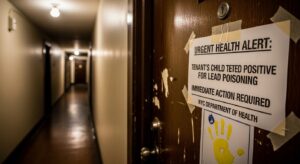
The DOHMH issues lead paint violations when a child in a building tests positive for an elevated blood lead level (EBLL). Once a violation is issued, the department conducts an environmental investigation and may order the property owner to perform remediation.
Clearance testing is required after DOHMH-ordered abatement work. A certified clearance report must be submitted to the department to demonstrate that the hazard has been fully addressed. Without it, the violation remains open — and the risk of enforcement action continues.
NYC Housing Preservation and Development (HPD)
HPD enforces Local Law 1 and requires property owners of pre-1960 buildings (and pre-1978 buildings with children under six) to conduct annual visual inspections and address peeling lead paint hazards.
HPD issues several specific lead-related violation codes, each requiring clearance testing as part of the cure process:
Orders to Correct (Active Occupancy Violations)
These violations are issued when lead paint hazards are found in an occupied unit, typically where a child under six resides:
- Violation Code 616 – Lead-based paint hazard found; owner must remediate and provide clearance testing documentation
- Violation Code 617 – Lead paint violation related to deteriorated paint or friction/impact surfaces requiring abatement and clearance
- Violation Code 624 – Lead hazard violation issued following an inspection, requiring remediation and certified dust wipe clearance testing to cure
Turnover Violations (Unit Vacancy Violations)
These violations are issued when a unit with a child under six becomes vacant, and the owner fails to perform the required lead investigation and remediation before re-renting:
- Violation Code 621 – Failure to perform a lead investigation upon turnover of a qualifying unit
- Violation Code 622 – Failure to complete required remediation work discovered during a turnover investigation
- https://manhattanlead.com/hpd-turnover-violations-623-manhattan/ Violation Code 623 – Failure to perform lead dust wipe clearance testing following turnover remediation before re-renting the unit
For all of these violation types, lead dust wipe clearance testing is a mandatory step in the cure process. HPD will not accept a violation as cured without the proper certified clearance documentation on file. HPD violations that are not properly cured on time can result in the city performing emergency repairs and billing the owner, in addition to escalating civil penalties.
NYC Department of Buildings (DOB)
The DOB becomes involved when renovation or construction work disturbs lead paint. Under EPA’s Renovation, Repair, and Painting (RRP) Rule and NYC regulations, contractors must follow lead-safe work practices and, in many cases, clearance testing is required after the work is completed.
If a DOB stop-work order or violation is issued due to improper lead disturbance during construction, clearance testing documentation is a key part of demonstrating compliance and getting work back on track.
Who Can Perform Lead Dust Wipe Clearance Testing in NYC?
Not just anyone can collect clearance samples for regulatory purposes. In New York City, clearance testing must be conducted by a:
- New York State-certified lead inspector
- New York State-certified lead risk assessor
These professionals are trained and licensed to collect samples correctly, interpret results, and issue formal clearance reports that are accepted by DOHMH, HPD, and DOB. You can verify license status through the NYS Department of Labor.
It is also important that the clearance inspector is independent from the abatement contractor to avoid any conflict of interest and ensure objectivity.
How Manhattan Lead Can Help
Navigating lead paint regulations in New York City can be complex and stressful — especially when violations are involved. At Manhattan Lead, we are fully equipped to assist property owners, building managers, and landlords with all aspects of lead dust wipe clearance testing and violation resolution, including:
- Post-abatement clearance testing after any remediation or renovation work
- DOHMH violation response following elevated blood lead level investigations
- HPD violation clearance under Local Law 1 compliance requirements
- DOB compliance documentation after lead disturbance during construction
- Certified inspection and reporting accepted by all NYC regulatory agencies
Whether you are dealing with a single apartment or an entire building portfolio, Manhattan Lead provides fast, reliable, certified lead dust wipe clearance testing throughout New York City. Our goal is to help you achieve compliance, protect your tenants, and close out violations efficiently.
Contact Manhattan Lead Today
If you have received a lead paint violation from DOHMH, HPD, or DOB — or if you need clearance testing after abatement work — do not wait. Contact our team today to schedule a certified lead dust wipe clearance inspection. Call us at (212) 226-1614. We are here to help you resolve the issue safely, properly, and in full compliance with New York City law.