Everyone in your home drinks water directly from the tap with no filter or boiling. But what if that crystal clear water carries something dangerous that you cannot see, smell, or taste? Yes, we are talking about lead.
And if you live in New York City, this is not some faraway problem. It is happening right now in homes across all five boroughs.
Unidentified Lead – The Hidden Danger in Your Pipes
New York City has some of the best drinking water in the country. The water travels 125 miles from upstate reservoirs, and it arrives virtually lead-free. But the moment it enters your building or home, everything can change.
According to a 2024 report from the New York League of Conservation Voters, almost 30 percent of service lines in New York City are made of lead or could be made of lead. That breaks down to about 14 percent confirmed lead pipes and another 15 percent labeled as unknown material.
What does that mean in numbers? Roughly 1.3 million New Yorkers may be drinking water that flows through lead or possibly lead pipes. That is one in six people.
Your neighbor might have lead pipes. Your coworker might have them. You might have them and not even know it. That’s where lead water testing in NYC becomes important.
Why Lead Water Testing in NYC is Important?
Unlike other toxins, your body has no use for lead. When lead enters your system, it just causes damage. And the scariest part? There is no safe level of lead exposure. The CDC, the EPA, and the American Academy of Pediatrics all agree on this.
The World Health Organization estimates that lead exposure caused more than 1.5 million deaths globally in 2021. Most of those deaths came from heart problems linked to lead.
For children, the risks are even more serious:
- Brain and nervous system damage that cannot be reversed
- Slower growth and development
- Learning difficulties and behavior problems
- Hearing and speech issues
- Lower IQ scores
Young kids’ brains are still growing and making thousands of new connections every second. Lead disrupts this process in ways that can last a lifetime.
The effects of lead on a child can be permanent and irreversible. That is not us being dramatic. That is straight from health officials.
For adults, lead exposure brings its own set of problems:
- High blood pressure
- Joint and muscle pain
- Memory issues
- Fertility problems
- Kidney damage
And often, you will not even know you have been exposed until the damage is done. Many people with elevated lead levels show no symptoms at all.
How Does Lead Water Testing Work?
Lead water testing starts with collecting a sample from your tap. But there is a specific way to do this to get accurate results.
Most professionals will ask you to collect what is called a first draw sample. This means you need to let your water sit unused for several hours, usually overnight or at least six to eight hours. Then you fill the sample container without running the water first. This captures water that has been sitting in your pipes, which will have the highest lead concentration.
Some testing also includes a second sample after you flush the pipes by running the water for a minute or two. This helps determine if the lead is coming from your building pipes or from somewhere else in the system.
The samples then go to a laboratory for analysis. Labs use different methods to detect lead:
- Inductively coupled plasma mass spectrometry, which ionizes the sample to detect trace amounts of lead with high accuracy
- Anodic stripping voltammetry is an electrochemical technique that measures lead levels on an electrode
- X-ray fluorescence is a non-destructive method used commercially.
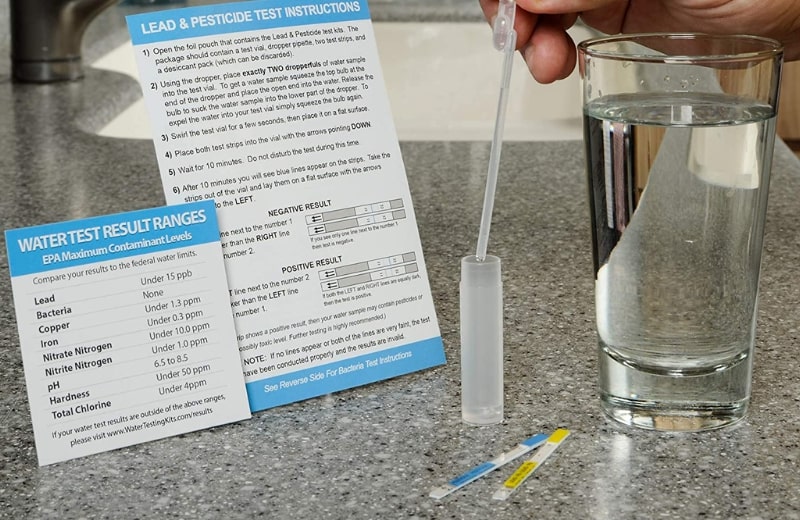
The EPA action level for lead in water is 15 parts per billion. However, remember that there is no safe level of lead. Even levels below 15 ppb can cause harm, especially to children.
A 2024 analysis found that 35 percent of home test kits submitted in New York City over the past decade showed some level of lead present. About 4.3 percent had at least one draw that exceeded the federal action level.
Those numbers should make anyone reading this think twice about skipping a lead test.
Also Read: Lead in Water vs Lead in Paint
What Happens If Your Water Has Lead?
Finding out your water has lead is scary. But it is also the first step toward fixing the problem. Do this next:
Flush your pipes before using water. If the water has been sitting for several hours, run the cold tap for at least 30 seconds to two minutes before using it for drinking or cooking. This clears out the water that picked up the most lead.
Always use cold water for drinking and cooking. Hot water leaches more lead from pipes than cold water does. Never use hot tap water to make baby formula, cook pasta, or prepare any food or drinks.
Consider a water filter certified for lead removal. Not all filters remove lead, so look for certification from NSF International specifically for lead reduction.
Look into pipe replacement. The city offers free lead service line replacement for eligible properties in certain neighborhoods. Replacing lead pipes is the only permanent solution, though it can cost between 10,000 and 15,000 dollars for homeowners who do not qualify for assistance.
When Should You Get Your Water Tested?
You should consider lead water testing in NYC if any of these apply to you:
- You live in a building built before 1986
- You have young children or someone pregnant in your home
- You have noticed a change in your water quality
- You have never had your water tested before
- Your property received a notification about potential lead service lines
- You recently did plumbing work or renovation
Pregnant women should be especially careful. Lead can pass from a mother to her unborn baby. Testing and taking precautions protect both.
Even if you rent, you have the right to know about your water quality. Ask your landlord about testing results or request that testing be done.
Free Lead Testing Options in NYC
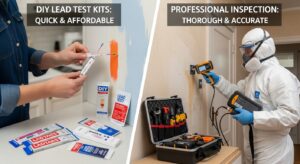
The city offers free lead test kits to residents. You can request one by calling 311 or visiting the NYC website. Due to high demand, there may be a wait, but it is worth signing up.
These free kits give you a general idea of your lead levels. However, they come with some limitations. The city handles thousands of requests, which can mean delays. And the results may not be as detailed as professional lead testing.
For more thorough results, especially if you have concerns about children or health issues, professional lead water testing in NYC gives you faster turnaround times, more detailed analysis, and expert guidance on what your results mean and what steps to take next.
What Makes NYC Buildings So Risky?
Lead pipes were banned in New York City back in 1961. Lead solder in plumbing got banned in 1987. But many buildings went up long before those bans. And those old pipes are still there.
If you live in a home or building built before the 1980s, you have a concern for sure. The older your building, the higher the risk.
Water sits in those old lead pipes overnight or during the day while everyone is at work. As it sits, lead leaches into the water. The longer the water stays still, the more lead it picks up.
This is why lead water testing in NYC is so critical. You cannot tell if your water has lead just by looking at it or tasting it. Testing is the only way to know for sure.
According to recent data, these areas have some of the highest concentrations of lead service lines:
- Jamaica, Queens and Pelham Throgs Neck in the Bronx come in at about 25 percent
- Southwest Queens sits at around 23 percent
- Ridgewood Forest Hills and West Queens both hover near 22 percent
- Long Island City and Astoria show about 21 percent
- Southeast Queens, Fordham Bronx Park, Greenpoint, and Kingsbridge Riverdale all range from 17 to 19 percent
Over 40 percent of known lead service lines across the city are located in disadvantaged communities. These neighborhoods already face more pollution exposure and fewer health resources. Lead in the water just adds another burden.
Call Professionals – Call Manhattan Lead
Manhattan Lead provides professional lead water testing services across New York City. Our certified team uses advanced equipment to give you accurate results fast. We test both residential and commercial properties throughout all five boroughs.
Our process is simple. Our team comes to you, collects the samples properly, and delivers clear results you can understand. No confusing lab reports. No guessing about what to do next.
Do not wait for symptoms to appear. Do not assume your building is fine because it looks fine.
Get your water tested. Get the answers you need. Get the protection your family deserves.
Call Manhattan Lead to schedule your lead water test today.