
NYC Local Law 31
Local Law 31 of 2020 requires NYC property owners to have every dwelling unit and common area tested for lead-based paint using an XRF analyzer, performed by an EPA-certified inspector. It applies to multiple dwellings built before 1960, and to buildings built between 1960 and 1978 where the owner knows lead paint is present.
The compliance deadline was August 9, 2025. Buildings that weren’t tested by that date are currently non-compliant.
Local Law 31 Compliance Experts
How We Work Under Local Law 31
Hire our dedicated compliance department to resolve violations, permit issues and licensure renewals. We offer mandated inspections, prevent late filings and resolve costly fines.
How Local Law 31 Fits With NYC's Other Lead Laws
- Local Law 1 (2004): Established the Childhood Lead Poisoning Prevention Act, requiring annual tenant notices, apartment turnover inspections, and remediation of lead-based paint hazards.
- Local Law 66 (2019): Lowered the legal definition of lead-based paint from 1.0 mg/cm² to 0.5 mg/cm², effective December 1, 2021.
- Local Law 31 (2020): Required XRF testing of all apartments in covered residential buildings by August 9, 2025.
- Local Law 111 (2023): Expanded XRF testing requirements to include common areas, such as hallways, stairwells, and lobbies.
Owners frequently assume that complying with one of these satisfies the others. It doesn’t they impose separate obligations.
This also means older test results may no longer demonstrate compliance. Testing performed before December 2021 was measured against a standard twice as permissive as today’s. A surface that passed at 0.8 mg/cm² then is lead-based paint now.
If your building was tested before December 2021, send us the report. We’ll tell you at no charge whether it still stands.
We offer



Local Law 31
In-House Lead Testing Experts
What Local Law 31 Requires
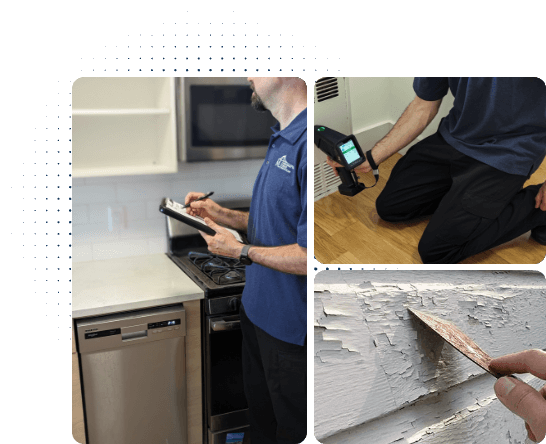
Local Law 31 of 2020 is New York City’s lead-based paint testing law. It builds on the Childhood Lead Poisoning Prevention Act (Local Law 1 of 2004), which established the city’s core protections against childhood lead exposure. Local Law 31 added a specific requirement: every dwelling unit and common area in a covered building must be tested for lead-based paint using an XRF analyzer, performed by an EPA-certified inspector.
The compliance deadline for covered buildings was August 9, 2025. Buildings that were not tested by that date are currently non-compliant, and the obligation remains outstanding.
A separate and shorter clock applies where young children are involved: when a child under six comes to reside in a covered unit, testing must be completed within one year of that child moving in.
If you own or manage a covered building and haven’t completed testing, call us with the address. We’ll tell you whether you’re covered and what scope you need at no charge.
Trusted Lead Testing Services
What Local Law 31 Requires of Owners
XRF testing is required on all painted surfaces in every dwelling unit and common area of a covered building. Visual inspections and consumer swab kits are not accepted.
Testing must be performed by an EPA-certified lead inspector or risk assessor.
The compliance deadline was August 9, 2025. Buildings not tested by then are currently non-compliant.
Where a child under six comes to reside in a unit, testing must be completed within one year of move-in.
Any surface reading 0.5 mg/cm² or higher is legally lead-based paint. This threshold was lowered from 1.0 mg/cm² by Local Law 66, effective December 1, 2021.
Common areas — hallways, lobbies, and stairwells — are covered, added by Local Law 111 of 2023.
Comprehensive Lead Inspections
Want to make your house compliant with Local Law 31?
Call our lead paint inspectors to make sure your home is fully compliant with Local Law 31
Local Law 31
In-House Lead Testing Experts
What Happens If You're Not Compliant
Failure to comply with NYC Local Law 31 can result in a Class “C” hazardous violation issued by the New York City Department of Housing Preservation and Development (HPD). These are among the most serious housing code violations and can lead to enforcement actions if they are not corrected.
Since August 9, 2025, property owners must maintain complete XRF lead paint testing records for all covered apartments and common areas. If HPD issues a lead-based paint hazard or turnover violation, it may require owners to produce these records promptly as part of the enforcement process.
If a child living in the building is found to have an elevated blood lead level, the New York City Department of Health and Mental Hygiene (DOHMH) may initiate a separate investigation and enforcement process, which can proceed independently of HPD’s actions.
Even if you’ve missed the original compliance deadline, completing the required XRF testing as soon as possible is still important. Prompt testing helps identify potential lead hazards, reduces ongoing exposure risks, and ensures you have the documentation needed if HPD requests proof of compliance in the future.
Efficient Lead Testing Solutions
What Are Lead Paint Based Hazards?
Lead-based paint was banned for residential use nationally in 1978. New York City restricted its use earlier, in 1960, which is why 1960 is the city’s testing threshold. But buildings on both sides of that date can contain lead paint, and many older NYC buildings do.
Intact, well-maintained lead paint is generally not an immediate hazard. Risk arises when it deteriorates chipping, peeling, or flaking or when it’s disturbed by friction, renovation, or sanding. That’s what generates lead dust, and lead dust is the primary exposure route for young children.
Lead exposure is associated with damage to the developing nervous system. Children under six are most vulnerable because their nervous systems are still developing.
Other causes of lead based paint poisoning include;
- Dust from deteriorating paint the primary exposure route for young children
- Friction surfaces: windows, doors, and frames that grind with use Peeling, chipping, or flaking paint on walls, sills, and trim
- Crumbling plaster or rotted wood beneath painted surfaces Painted surfaces within reach of small children
- Renovation or repair work that sands, scrapes, or disturbs paint
Identify lead paint hazards
Does Local Law 31 Apply to My Building?
| Building Type | Covered? |
|---|---|
| Multiple dwelling built before 1960 | Yes — regardless of whether children live there |
| Built 1960–1978, owner knows lead paint is present | Yes |
| Built 1960–1978, no knowledge of lead paint | Generally No — but federal disclosure requirements and NYC turnover rules may still apply |
| Built after 1978 | No — lead paint was banned nationally in 1978 |
| Condo or co-op that is rented or sublet | Yes |
| Condo or co-op occupied by the owner or their family | Exempt |
| Common areas (hallways, lobbies, stairwells) | Yes — added by Local Law 111 of 2023 |
Why both 1960 and 1978 matter?
These two dates get confused constantly, and they mean different things.
1978 is when lead-based paint was banned nationally for residential use. Any building from 1978 or earlier may contain it. This drives federal disclosure obligations when a property is sold or leased.
1960 is New York City’s testing threshold. Buildings from before 1960 carry substantially higher risk, so the city requires testing automatically — without the owner needing to suspect anything.
Buildings between 1960 and 1978 are not automatically safe. Lead paint was still legal and still widely used during those years. New York City simply doesn’t mandate blanket testing for them unless the owner already knows lead is present.
Customized Lead Testing Services
Does Local Law 31 Apply to Condominiums?
Yes, for units that are rented out. Every condo or co-op unit that is rented or sublet is subject to Local Law 31’s XRF testing requirements, the same as any other rental unit.
If the unit is occupied by the owner or their family, it’s exempt. The distinction is occupancy, not ownership structure — so a shareholder who lives in their unit is exempt, while the same shareholder renting it out is not.
If you own multiple units in a building and rent some of them, only the rented units are covered.
In-House Lead Testing Experts
The One-Year Rule for Units With Young Children
When a child under six comes to reside in a covered unit, XRF testing must be completed within one year of that child moving in.
This is a rolling obligation, not an expired deadline. It resets every time a family with a young child moves into a covered unit. If a tenant has a baby, or a household with a small child signs a lease next month, a new one-year clock starts then.
For owners of covered buildings, Local Law 31 is not a one-time task that ended in August 2025. It’s an ongoing compliance obligation tied to occupancy.
Knowledgeable lead paint professionals
FAQ'S
FAQ'S
Local Law 31 of 2020 requires NYC property owners to have all dwelling units and common areas tested for lead-based paint using an XRF analyzer, performed by an EPA-certified inspector. It applies to multiple dwellings built before 1960, and to buildings built between 1960 and 1978 where the owner knows lead paint is present.
August 9, 2025. Buildings not tested by then are currently non-compliant, and the obligation remains outstanding.
If the unit is rented or sublet, yes. If it’s occupied by the owner or their family, it’s exempt.
Only where the owner has actual knowledge that lead-based paint is present. Buildings built before 1960 are covered automatically.
Yes. When a child under six comes to reside in a covered unit, testing must be completed within one year of move-in. This applies regardless of the August 2025 deadline.
Possibly not. The threshold was lowered from 1.0 to 0.5 mg/cm² effective December 1, 2021, and common areas were added in 2023. Send us the report and we’ll review it at no charge.
Ten years, and they must be produced to HPD on request.
Yes — Manhattan, Brooklyn, Queens, The Bronx, and Staten Island.